Loading the homepage
Blog/Strategy
Instagram AI content rules in 2026
The short answer is no. Meta labels AI content, it does not demote it for being AI. The rule that quietly costs creators their reach is originality, and it applies to human footage just as hard.
RP
Rhea Park
growth lead, Deeporax
Reviewed by Matt Torres, Founder, Deeporax
Published Aug 3, 202618 min read · fact-checked

Key takeaways
- Meta does not reduce distribution for content because it was made with AI. Instagram's own labelling documentation treats disclosure as an information layer, and Meta's monetization policy withholds money for unoriginal content, not for synthetic content, so an AI Reel with original narration and editing is eligible where a reposted clip is not.
- The rule that actually costs reach is originality. Instagram confirmed in April 2026 that accounts repeatedly posting unoriginal photos and carousels lose access to recommendations entirely, which removes the single largest source of non-follower reach on the platform.
- Enforcement runs as a ladder with three rungs: reduced distribution first, loss of recommendations second, then loss of monetization eligibility. Each rung is account level rather than post level, so one bad batch of reposts can suppress work you publish weeks later.
Does Instagram ban AI-generated content in 2026?
No. Instagram does not ban AI-generated content, and as of August 2026 there is no policy on the books that removes, demotes or demonetizes a post purely because a model produced the pixels. This is the single most common misreading of Meta's 2026 rule changes, and it sends a lot of creators down the wrong road: they spend weeks trying to make their output look less synthetic when the thing actually holding their account back has nothing to do with AI at all.
What Meta did do in 2026 is tighten two separate things at the same time, which is why they get confused for each other. The first is disclosure. Instagram and Facebook want AI-generated media labelled, either automatically from embedded provenance metadata or manually by the person posting it. The second is originality. Meta announced in the spring that accounts which repeatedly publish content lifted from elsewhere without meaningful contribution would lose distribution, lose recommendations, and eventually lose monetization access.
Those two changes landed close enough together that the creator internet welded them into one rumour: Instagram is cracking down on AI. It is not. It is cracking down on recycling. The distinction matters enormously if you publish faceless content, because a generated video that you wrote, scripted, voiced and edited is original by Meta's own definition, while a trending clip you downloaded and reuploaded is not, no matter how human the footage looks.
Every account we have seen fall out of recommendations fell out for reposting, not for generating. The model that made the frames has never once been the variable that mattered.
Rhea Park, growth lead, Deeporax
There is a second reason this confusion persists. A great deal of low-effort AI content genuinely is unoriginal, because the fastest way to produce it is to feed someone else's viral video into a tool and get a near-copy out. That content gets penalized, the creator sees the penalty, and the causal story they tell themselves is that AI got them. The tool was never the trigger. The recycling was. We covered the same misattribution on the other side of the industry in our breakdown of TikTok's AI content policy, where the wording differs but the underlying logic is identical.
What does Meta actually require you to label?
Instagram operates a disclosure system rather than a ban. When the platform can tell that media was generated or materially edited by AI, it attaches an informational marker, historically surfaced as an AI Info entry in the post's detail menu or a visible tag near the username. Instagram's help documentation describes both a manual labelling control available before you publish and an automatic path triggered by provenance metadata inside the file.
The automatic path is the one most creators never think about. Major image and video models now embed Content Credentials following the C2PA specification, a cross-industry provenance standard that writes tamper-evident assertions about origin, editing history and AI authorship directly into the file. Meta reads that manifest at upload and applies the label without asking you. This means that on a lot of uploads, disclosure is already handled and the decision was made by the generator, not by you.
The manual path covers everything the automatic path misses: output from tools that strip metadata, footage assembled in editors that do not write C2PA manifests, or AI elements layered into otherwise real footage. Instagram exposes a labelling toggle in the advanced settings sheet during the posting flow, and its Generative AI Editing Disclosures documentation sets out when creators are expected to reach for it.
| What you published | Label expected? | How it usually gets applied |
|---|---|---|
| Fully AI-generated video clip or animation | Yes | Automatic from C2PA provenance metadata, or manual toggle if the file carries none |
| AI-generated still images in a carousel or slideshow | Yes | Automatic if the generator embeds Content Credentials, otherwise manual |
| Real footage with an AI voiceover added | Yes | Usually manual, since most editors do not write provenance data for the audio track |
| Real footage with AI-assisted colour, captions or cropping | No | Treated as ordinary editing, not generative creation |
| Standard filters, presets and template overlays | No | Explicitly outside the disclosure requirement |
| Real footage with an AI-generated background or object inserted | Yes | Manual disclosure, because the inserted element is newly generated visual content |
Compiled from Instagram Help Center labelling documentation and the C2PA Content Credentials specification.
Here is the part worth internalising: the label is metadata, not a penalty. Nothing in Meta's published policy ties the presence of an AI marker to reduced distribution, and Meta's own product surfaces are full of AI-generated media. Creators who hide the label to protect their reach are optimising against a mechanism that does not exist, and they are taking on real risk in exchange, because undisclosed synthetic media is a policy violation while disclosed synthetic media is simply content.
What counts as unoriginal, and why is that the rule that costs you reach?
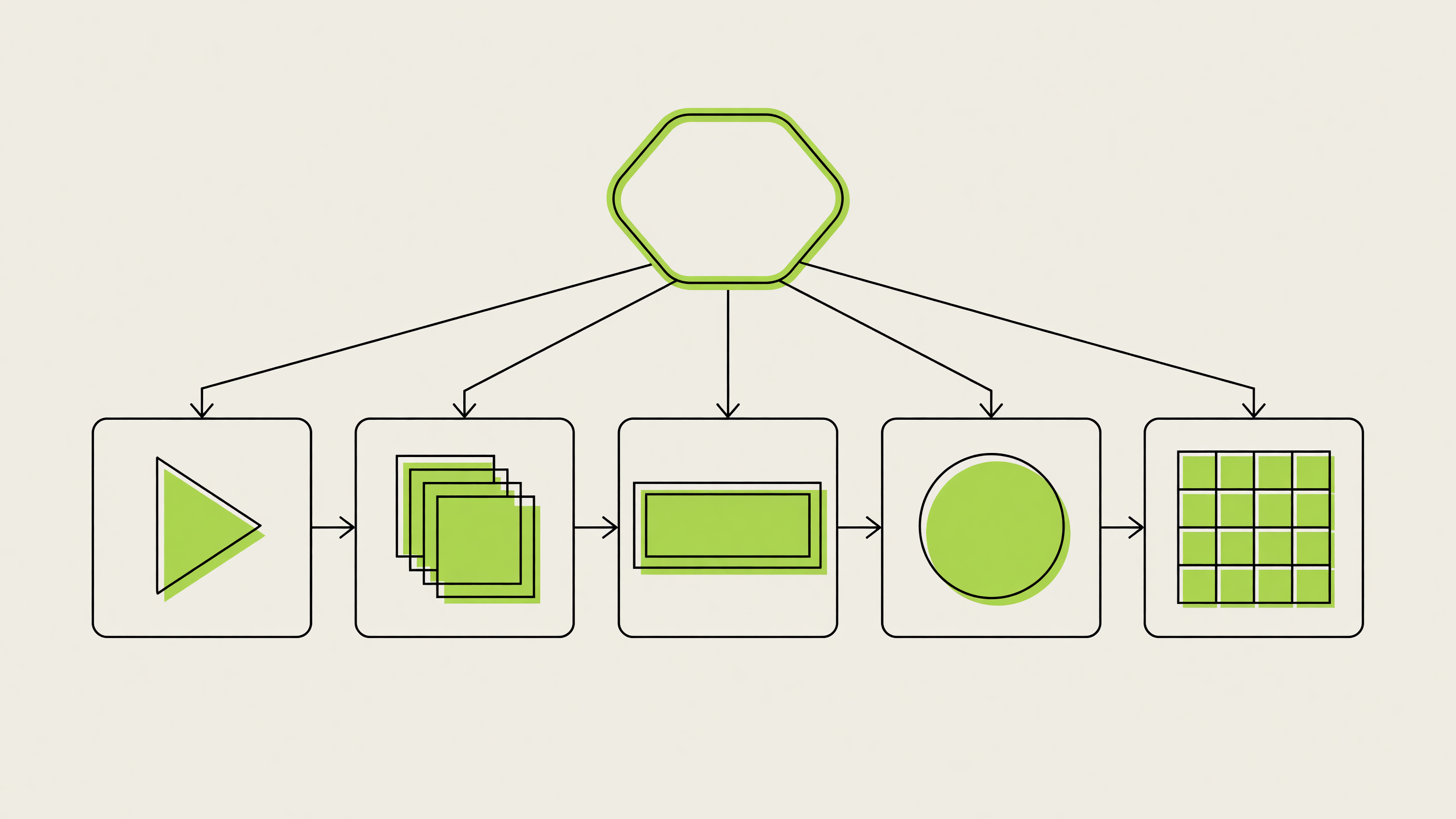
In April 2026 Instagram confirmed that its recommendation algorithm would begin penalizing unoriginal photo and carousel posts, extending an approach it had already been applying to video. Coverage at the time framed it bluntly: accounts that build a following by aggregating other people's work lose access to recommendations. Meta published the parallel Facebook announcement under the banner of rewarding original creators, and the two changes are enforced as one philosophy across both apps.
The operative phrase in Meta's monetization policy is meaningful enhancement. Content that is reproduced from another source without a meaningful contribution cannot be monetized, and by extension does not earn full distribution. Meta has been unusually specific about what does not count. A watermark does not count. A credit in the caption does not count. Cropping does not count. Adding a trending audio track does not count.
What does count is contribution that changes the informational value of the asset: original narration, original commentary, original graphics, original editing that reframes the material into something the source did not contain. If a viewer would get the same thing from the original, you have republished. If they would get something the original could not give them, you have created.
Read that standard carefully and you notice something that should be reassuring if you publish faceless content. A generated video built from your own script, your own structure and your own voice track clears the bar comfortably. It has no source to be unoriginal relative to. The asset did not exist before you made it. Meanwhile the creator filming themselves on a phone, reading a listicle they copied from a competitor, is much closer to the line than they realise. Originality is a property of the contribution, not of the camera.
This is also why the penalty catches so many accounts by surprise. It is scored at the account level over a rolling window, not judged post by post at publish time. You do not get an error message. You get a slow, unexplained decline in non-follower reach that starts weeks after the behaviour that caused it, which is exactly the failure mode we described in our guide to warming up a new account, where account-level trust accumulates or erodes long before any individual post is affected.
How does Meta actually enforce the originality rule?
Enforcement runs as a ladder rather than a switch. Understanding the rungs tells you which symptom you are looking at, and roughly how far down you have already gone.
Rung one is reduced distribution. Your posts still publish, still appear to followers, and still show up in search, but they surface lower in ranked feeds and get pushed to fewer non-followers. On a dashboard this reads as reach falling while engagement rate on the reach you do get stays flat, which is the diagnostic signature worth memorising. If your engagement rate had collapsed alongside reach, the problem would be your content. If engagement rate held and reach fell, the problem is your distribution.
Rung two is removal from recommendations. This is the expensive one. Instagram stops showing your work in Explore, in the Reels feed for non-followers, and in the suggested-posts placements that make up the large majority of discovery for growing accounts. Your follower reach survives, so a large existing audience masks the damage while a small one feels it as total collapse.
Rung three is loss of monetization eligibility. Meta's partner monetization policies gate payouts on originality directly, so an account flagged for repeated unoriginal posting can be pulled out of the Content Monetization Program for a period even while it continues to post normally. Reporting on the 2026 rollout described accounts losing access to in-stream ads, bonuses and performance payouts under this rung.
| Rung | What you observe | What still works | First thing to check |
|---|---|---|---|
| 1. Reduced distribution | Reach falls, engagement rate on delivered reach holds steady | Followers, search, profile visits, hashtags | How many of your last 30 posts contain material you did not create |
| 2. No recommendations | Non-follower reach approaches zero, follower reach normal | Everything inside your existing audience | Account status tools in the professional dashboard |
| 3. Monetization removed | Payout dashboard shows ineligible, bonuses stop | Publishing, organic reach at whatever rung you sit on | Partner monetization policy notices in your inbox |
Structured from Meta partner monetization policy language and 2026 reporting on the originality rollout.
Two properties of this ladder deserve emphasis. It is account level, so the penalty travels with the profile rather than the post, and deleting the offending uploads does not reset the clock instantly. And it is rolling, so it decays: sustained original publishing pulls an account back up the ladder over a period of weeks rather than requiring an appeal.
Meta also shipped the mirror image of the rule. Its content protection tooling detects when an original Reel is copied and reposted, and offers the original creator the option to block the copy across Instagram and Facebook, attach attribution, or release the claim. That system only makes sense if Meta can already identify duplicate media at scale, which tells you the originality classifier is a matching problem rather than a judgement call.
What do these rules mean for money on Facebook and Instagram?
Meta consolidated its creator payouts into a single Content Monetization Program, folding in-stream ads, ads on Reels and the performance bonus into one dashboard and one payout logic. The practical consequence for creators is that originality is now upstream of every revenue line at once. Under the old structure a demotion in one program left the others intact. Under a unified program, an originality flag touches everything.
Meta has been investing heavily on the other side of that equation. The company reported paying creators roughly three billion dollars in 2025, up around 35 percent year over year, and in March 2026 launched Creator Fast Track, a program offering guaranteed pay and increased reach to accelerate creators onto Facebook. CNBC reported the same month that Meta was courting established Instagram, TikTok and YouTube creators with direct payments to publish on Facebook. The money is real and it is growing, which is precisely why the originality gate exists.
| Metric | Reported figure | What it means in practice |
|---|---|---|
| Facebook CMP follower threshold | 10,000 followers on a Page or professional-mode profile | Reachable in months of consistent publishing, not years |
| Facebook CMP watch-time threshold | 600,000 total minutes watched across videos | Favours volume and consistency over a single viral hit |
| Facebook Reels RPM, typical range | Roughly $0.02 to $0.20 per 1,000 views, median around $0.05 to $0.10 | Per-view income is a volume game, not a per-post game |
| Facebook Reels RPM, strong niches | $0.50 and above reported for US-heavy, high-value verticals | Audience geography moves the number more than view count does |
| Creator revenue share on ad revenue | Around 55 percent to the creator | Consistent with Meta's long-running in-stream split |
| Total paid to Facebook creators, 2025 | Approximately $3 billion, up about 35 percent year over year | The pool is expanding, which raises the value of staying eligible |
Aggregated from Meta newsroom announcements and published 2026 creator-payout reporting. RPM figures are third-party aggregate estimates and vary widely by niche and audience geography.
Treat those RPM ranges as orientation rather than forecast. Per-view rates on Meta are among the most variable in the industry because they track advertiser demand against your specific audience, and a creator with a US finance audience and a creator with a global entertainment audience can differ by an order of magnitude at identical view counts. The reliable read is directional: Meta pays on volume, volume depends on recommendations, and recommendations depend on originality.
For anyone weighing where to put production effort, this changes the arithmetic in a way worth stating plainly. Because eligibility is account level and the payout pool is unified, one recycled batch can cost you the earnings of every original post you publish for the rest of the enforcement window. The expected cost of reposting is not the reach of the reposted item. It is the reach of everything downstream of it.
How do Meta's rules compare to TikTok, YouTube and X?
If you publish to more than one platform, and most faceless operations do, the useful question is not what Instagram wants in isolation. It is where the five major platforms agree and where they diverge, because agreement is what lets one asset travel and divergence is what forces a variant.
The good news is that the convergence is substantial. Every major platform now asks for disclosure of realistic synthetic media, and every major platform penalizes low-effort recycled content while explicitly permitting AI-assisted creation. The differences are in emphasis and in how each one describes the failure mode.
| Platform | Stance on AI-generated content | Disclosure mechanism | What actually gets penalized |
|---|---|---|---|
| Permitted, including in Reels and carousels | Automatic from C2PA metadata, plus a manual toggle before posting | Unoriginal photos and carousels, enforced by loss of recommendations | |
| Permitted across Reels, video and photo formats | Same Meta labelling system as Instagram | Unoriginal content, enforced through the unified Content Monetization Program | |
| TikTok | Permitted, with AI-generated label required for realistic media | Manual AI-generated toggle plus automatic Content Credentials reading | Unoriginal and low-quality content under the recommendation eligibility rules |
| YouTube | Permitted, with altered-or-synthetic disclosure in the upload flow | Required disclosure field for realistic synthetic media | Inauthentic and mass-produced repetitious content under monetization policy |
| X | Permitted, with synthetic media rules focused on deceptive use | Community-driven context plus platform labelling | Deceptive synthetic media, plus reach limits on duplicate and spammy posting |
Compiled from each platform's published policy documentation and 2026 cross-platform AI disclosure reporting.
The pattern across that table is one sentence long: nobody penalizes synthesis, everybody penalizes duplication. That is a genuinely convenient state of affairs for anyone running one production pipeline across several destinations, because it means the compliance work is shared. Get originality right once and it holds on all five. Get disclosure right once and the mechanism is broadly the same, with C2PA doing the heavy lifting automatically on the platforms that read it.
Where you do need per-platform thinking is format and cadence rather than policy. A single script can become a Reel, a Short, a vertical clip, a carousel and a text post, and each of those lands differently against its own ranking system. We worked through the reach differences between static formats and video in our comparison of slideshows against videos, and the same logic extends across platforms: the asset is portable, the packaging is not.
YouTube's version of this rule is the most explicitly worded of the five and worth reading directly if you produce at volume, since its language about mass-produced repetitious content sets a bar that some template-driven pipelines fail without realising it. We broke that policy down separately, and the fix there is the same fix as here: variation in substance, not variation in wrapper.
What separates accounts that keep their recommendations from ones that lose them?
The two patterns below are illustrative composites drawn from the shapes we see repeatedly across accounts running automated publishing. They are not measurements of a single named account, and the numbers describe the pattern rather than a specific audited result.
Pattern one, the aggregator that stalls. An account picks a broad niche, sources trending clips from other creators, adds a caption and a trending audio, and publishes ten to fifteen times a week. Early growth is genuinely fast, because the material is pre-validated: it already worked somewhere else. Somewhere between week six and week ten the curve flattens hard. Follower growth does not go negative, it goes flat, and non-follower reach drifts toward a floor. The operator's instinct is to publish more, which accelerates the problem, because volume of unoriginal material is exactly the input the classifier is scoring.
The recovery move is unintuitive and slow: cut publishing volume, stop sourcing external footage entirely, and rebuild the queue from generated or self-produced assets with original narration. Distribution returns over weeks, not days, because the rolling window has to age out. Operators who instead start a fresh account carry the same sourcing habit onto it and reproduce the ceiling.
Pattern two, the pipeline that compounds. An account defines a narrow subject, writes original scripts, generates visuals to match those scripts, records or synthesises a consistent voice, and publishes on a steady cadence to several platforms at once. Early growth is slower, sometimes markedly so, because nothing is pre-validated and the first thirty posts are effectively research. But the reach curve does not flatten in the same way, because there is no accumulating originality debt to pay down.
What makes the second pattern work is not effort per post. Both operators are working. The difference is that the second one owns the source material, which means every downstream use is original by construction and every platform's originality rule is satisfied automatically rather than by argument.
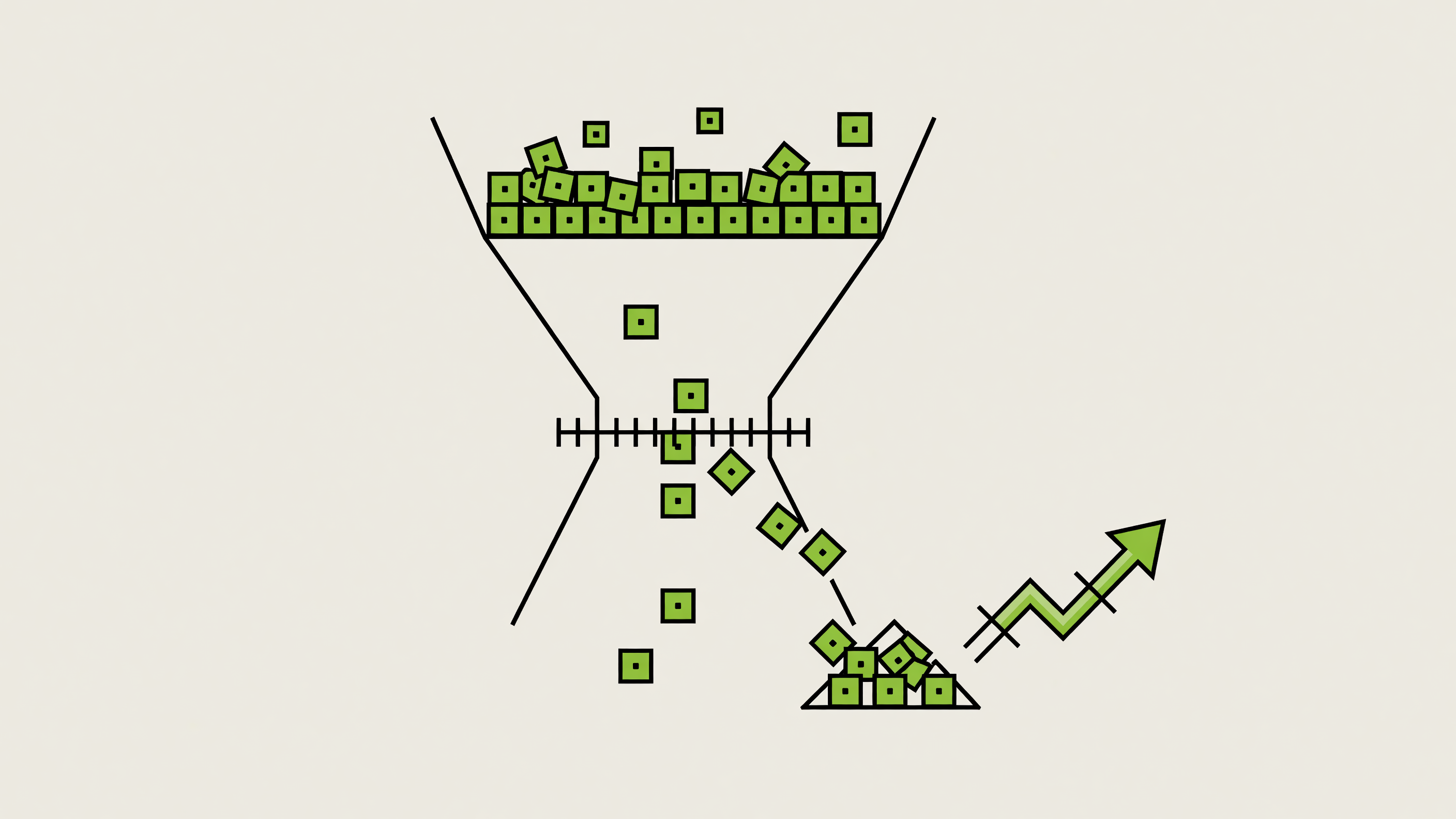
There is a third pattern worth naming because it fools people: the hybrid. An operator produces original content most of the time and reposts occasionally when the queue runs dry. Because the majority of the output is original, they assume they are safe. The classifier is not scoring your average, it is scoring occurrences within a window, and reporting on the 2026 rollout described thresholds tied to counts of reposts in a rolling period. Occasional recycling under deadline pressure is the most common way good accounts fall down rung one without ever understanding why.
What does a compliant publishing workflow actually look like?
Everything above reduces to a workflow with five checkpoints. None of them are expensive individually. The reason accounts fail is that the checkpoints are easy to skip under volume pressure, which is the exact condition every serious publishing operation lives in.
One: own the source. Before anything else, be able to answer where the raw material came from. Generated from your prompt, filmed by you, or licensed with rights that permit the use. If the honest answer is that you found it, the rest of the workflow cannot save the post.
Two: add the contribution that makes it yours. Original narration is the highest-leverage single addition, because it is what platforms consistently name as qualifying enhancement and because it survives reformatting across every destination. Original structure and original on-screen graphics stack on top of it.
Three: disclose without flinching. If the media is generated, let the label attach. Check whether your generator writes C2PA Content Credentials, because if it does the disclosure is automatic and any effort to strip it is both futile and a policy risk. If it does not, use the manual toggle. The label costs you nothing in distribution and buys you a defensible position.
Four: vary the substance, not the wrapper. Template-driven pipelines fail originality checks when the only thing changing between posts is the text layer over an identical structure. Vary the argument, the example, the data and the angle. If a viewer could see three of your posts in a row and learn the same thing three times, a ranking system can tell too.
Five: distribute wide rather than deep. Because the originality rules converge across platforms while the ranking systems do not, the highest-return move available to a faceless operation is publishing the same original asset, correctly packaged, to every surface at once. One script becomes a Reel, a Short, a TikTok, a Facebook video and a post on X. The compliance work was already done once. The reach is additive.
That last point is where automation earns its place. The work of reformatting, scheduling and posting one asset across five platforms on a consistent cadence is mechanical, repetitive and precisely the sort of thing that degrades when a human does it at eleven at night. Deeporax generates the content and runs the posting on autopilot across TikTok, Instagram, YouTube, X and Facebook, which keeps cadence steady and keeps every destination fed from the same original source. The strategic thinking behind what to publish is covered in our broader piece on faceless marketing.
One closing caution on hooks. Originality applies to your opening line as much as your footage, and hook libraries scraped wholesale from other accounts are one of the fastest ways to look duplicative to a classifier that is matching text as well as media. Write hooks against your own material, and if you need a starting point, work from patterns rather than copied lines.
Frequently asked questions.
Does Instagram delete AI-generated Reels?+
No. Instagram does not remove content for being AI-generated. Removal happens for violations of the Community Standards, which apply to synthetic and real media identically: impersonation, deceptive manipulation of real events, adult content, harassment and so on. A generated Reel that breaks none of those rules stays up. What Instagram does apply to AI media is a disclosure label, which is informational rather than punitive. If your AI Reels are disappearing, the cause is a Community Standards issue or a copyright claim on borrowed source material, not the generation method itself.
Will using AI hurt my Instagram reach?+
Not by itself. Meta has published no policy tying reduced distribution to AI authorship, and the labelling system exists to inform viewers rather than to demote posts. Reach damage in 2026 overwhelmingly traces to the originality rules, which penalize content reproduced from other sources without meaningful contribution. Because a lot of AI workflows involve feeding someone else's viral video into a tool, the two get conflated. If your AI content is built from your own scripts and your own narration, the originality rules are on your side rather than against you.
Do I have to label AI content on Instagram?+
Yes, for content that is generated or materially altered by AI in ways that could be mistaken for real. Instagram provides a manual labelling control in the advanced settings of the posting flow, and it also detects C2PA Content Credentials embedded by many generators and applies the label automatically. Ordinary editing does not require disclosure: filters, colour correction, cropping, captions and template overlays are outside the requirement. The line sits at newly generated visual or audio content, not at AI-assisted adjustment of media you already had.
What is the difference between the AI label and the originality rule?+
They are unrelated systems that landed in the same year. The AI label is a disclosure mechanism: it tells viewers how media was made and carries no distribution consequence. The originality rule is an enforcement mechanism: it reduces distribution, removes recommendations and can suspend monetization for accounts that repeatedly publish content lifted from elsewhere. You can be fully labelled and fully distributed at the same time. You can also be entirely human-made and heavily penalized, if what you post is other people's work.
Does Facebook follow the same AI rules as Instagram?+
Broadly yes. Meta operates labelling and originality policy across Facebook and Instagram as one framework, and its 2026 announcements about rewarding original creators covered both apps. The main practical difference is on the money side: Facebook's Content Monetization Program is the unified payout system where originality eligibility is enforced against ad revenue, bonuses and in-stream earnings together. Instagram's penalty is felt primarily as loss of recommendations. Same rule, different pressure point, so an account can feel the effect on one app before noticing it on the other.
How do I add the AI label before posting on Instagram?+
Open the advanced settings sheet in the posting flow, before you publish rather than after, and enable the AI labelling control. If your generator writes C2PA Content Credentials into the file, you may find the label has already been applied automatically at upload and no action is needed. Check whether the marker appears on a test post from your specific tool chain, because behaviour varies: some generators embed provenance, some strip it during export, and editors that re-encode video frequently discard the manifest without warning.
Does adding a voiceover make reposted content original?+
It helps substantially, and it is the enhancement platforms name most consistently, but it is not automatically sufficient. The standard is meaningful contribution that changes what a viewer gets from the asset. A voiceover that adds analysis, context or commentary the original lacked is a genuine contribution. A voiceover that narrates what is already visible on screen is decoration. The safest structure is to own the source material outright, so originality is a property of how the asset was made rather than an argument about how much you added afterwards.
How many reposts before Instagram stops recommending my account?+
Meta has not published an exact number, and treating any figure as authoritative is a mistake. Reporting on the 2026 rollout described thresholds based on counts of unoriginal posts within a rolling window rather than a lifetime total, with commonly cited figures in the range of roughly ten reposts in thirty days. Treat that as a directional signal from secondary sources, not a limit to operate near. The workable policy is to hold unoriginal posting at zero, which removes the need to guess where the boundary sits.
Can I publish the same video to Instagram, TikTok, YouTube, Facebook and X?+
Yes, and it is usually the highest-return thing you can do with an asset you own. Cross-posting your own original content is not what the originality rules target: they target reproducing other people's work. Each platform will rank the upload against its own system, so packaging matters, meaning aspect ratio, caption style, hook length and cadence should suit the destination. The asset travels, the wrapper does not. Publishing the same original source to all five surfaces multiplies reach without multiplying production cost.
Should I strip C2PA metadata so the AI label does not appear?+
No, on two grounds. Practically it often fails, because Meta applies labels through multiple detection paths and manual disclosure obligations remain regardless of what the file contains. Strategically it is a bad trade: undisclosed synthetic media is a policy violation with real enforcement consequences, whereas disclosed synthetic media carries no distribution penalty at all. You would be accepting genuine risk to avoid a cost that does not exist. Let the label attach and spend the saved effort on originality, which is the variable that actually moves reach.
My reach dropped suddenly. How do I tell if it is the originality penalty?+
Compare reach against engagement rate on the reach you still receive. If reach fell while engagement rate on delivered impressions held steady, distribution was throttled and the content itself is fine, which points at an account-level penalty. If both fell together, the content stopped resonating and this is an ordinary performance problem. Then split follower reach from non-follower reach: a collapse concentrated almost entirely in non-follower reach is the signature of losing recommendations, which is rung two of the originality ladder.
How long does it take to recover from an originality penalty?+
Weeks rather than days, and there is generally no appeal to file because nothing was formally actioned against you. The scoring runs over a rolling window, so recovery happens as the offending posts age out of that window while new original posts accumulate. Deleting old reposts does not reset the clock instantly. The reliable approach is sustained original publishing at a steady cadence, with unoriginal sourcing cut to zero, and patience through a period where output feels disconnected from results.
Why did my AI content work for months and then stop?+
Almost always because an account-level threshold was crossed rather than because a policy changed under you. Originality scoring is cumulative over a rolling window, so a habit that was harmless at low volume becomes a penalty once enough instances stack up inside the window. The second common cause is template fatigue: pipelines where only the text layer changes between posts start reading as repetitious, which trips originality logic on several platforms even when every asset was technically self-produced.
Does Instagram detect AI content that I do not label?+
Sometimes, through more than one route. The clearest is C2PA provenance metadata embedded by the generator, which Meta reads at upload and acts on automatically. Beyond that, Meta operates classifier-based detection of synthetic media, though no such system catches everything. The practical risk calculation does not depend on detection rates: because disclosed AI content carries no distribution penalty, there is no upside to concealment and a real downside if it is caught. Label it and move on.
Do I lose monetization if my content is labelled as AI?+
No. Meta's monetization policies gate eligibility on originality, authenticity and Community Standards compliance, not on whether content was AI-generated. Labelled AI content that is original, discloses properly and complies with the standards remains monetizable under the Content Monetization Program. What does cost you monetization is reproducing other sources without meaningful enhancement, which the partner monetization policies exclude explicitly. Creators who assume the AI label blocks payouts are usually looking at an originality flag and misreading its cause.
Sources.
- Meta Newsroom, Rewarding Original Creators on Facebook (Meta's announcement of reduced distribution and monetization loss for unoriginal content)
- Meta Newsroom, Creator Fast Track (guaranteed pay and increased reach program for Facebook creators, March 2026)
- Engadget, Instagram's recommendation algorithm will penalize unoriginal photo and carousel posts (scope of the April 2026 change)
- Tubefilter, Instagram has a new penalty for unoriginal content aggregators: No recommendations (enforcement detail and timing)
- eMarketer, Instagram's algorithm clamps down on repurposed, unoriginal photos and posts (industry analysis of the rollout)
- Instagram Help Center, Label AI content on Instagram (the manual disclosure control in the posting flow)
- Instagram Help Center, Generative AI Editing Disclosures (when disclosure is expected for AI-edited media)
- Instagram Help Center, About AI creators on Instagram (how AI-related labels surface to viewers)
- Meta Business Help Center, Partner Monetization Policies (the meaningful enhancement standard that gates payouts)
- Meta Transparency Center, Community Standards (the removal rules that apply to synthetic and real media alike)
- Meta Transparency Center, Reducing the distribution of problematic content (how demotion works as distinct from removal)
- C2PA, Content Credentials FAQ (the provenance standard Meta reads to apply AI labels automatically)
- C2PA Specifications, Content Credentials Explainer 2.4 (what a provenance manifest asserts about AI authorship)
- CNBC, Meta will pay Instagram, TikTok and YouTube creators with big followings to post on Facebook (scale of Meta's 2026 creator spending)
- Influencer Marketing Hub, AI Disclosure Rules by Platform (cross-platform comparison of labelling requirements)
- RouteNote, Meta cracks down on unoriginal content (summary of the penalty ladder and what counts as a material edit)
- Bitdefender, Facebook's Crackdown on Reposted Content: What Creators Need to Know (creator-facing analysis of enforcement)
- RouteNote, Meta is helping creators protect their original content across Instagram and Facebook (the duplicate-detection tooling behind the originality system)
- SocialBee, 2026 Instagram updates, news and features (running log of Instagram product changes through July 2026)
- Hootsuite, Instagram algorithm tips for 2026 (ranking signal reporting including watch time and sends per reach)
- Deeporax first-party observation across faceless publishing accounts running automated multi-platform posting, used for the illustrative patterns in the case study section and the reach-versus-engagement diagnostic
RP
Written by
Rhea Park
Rhea runs growth at Deeporax and spends most of her week reading platform policy updates so creators do not have to. She has managed faceless publishing across Instagram, TikTok, YouTube, Facebook and X since 2023, and has watched the same three mistakes take accounts out of recommendations every single time.