Loading the homepage
Blog/Strategy
Faceless marketing.
Build content that drives traffic and income without ever showing your face. Here's the real playbook: formats, niche selection, monetization, and where automation actually helps.

Deeporax Team
The Deeporax team
Reviewed by Rhea Park, TikTok growth lead
Published Jul 25, 202619 min read · fact-checked

Key takeaways
- Faceless pages win by treating the niche as the product, not a personality, which is what lets one team run five pages as easily as one.
- Photo Mode slideshows are TikTok's native faceless format: swipeable, searchable, and cheaper to produce than video, but excluded from the Creator Rewards Program.
- Real income comes from TikTok Shop affiliate commissions, brand deals, and an off-platform funnel (newsletter, digital product, storefront), not a single payout program.
- Automation should handle sourcing, formatting, and scheduling. The niche judgment, hook quality, and originality still need a human, or platforms will eventually flag the output as inauthentic.
What faceless marketing actually means.
Faceless marketing is the practice of building an audience, a brand, and eventually an income around a topic, a format, or a feed rather than a person's face and voice. No talking head, no personal Q&A sessions, no on-camera pressure to perform a personality every day. The niche is the product. The format is the deliverable. Whoever is behind the account could swap out entirely and the page would keep working, because nothing about it depends on one identifiable human showing up on screen.
That definition matters because faceless gets used loosely. It isn't the same as an anonymous brand, a company with no named founder, or a pseudonymous creator, a real ongoing persona who just uses a fake name, the way some finance or gaming YouTubers do. A faceless page can still have a consistent voice, a recognizable caption style, even a name. The dividing line is simpler: does the content require a specific person's face and live presence to exist, or could a different editor, a VA, or an automation pipeline produce next week's post without the audience noticing. If it's the second one, it's faceless marketing regardless of how personal the writing sounds.
I stopped trying to be a personality online. The page just has to be useful, every single day.
priya, Deeporax user
The category has grown past a workaround for shy creators. Digiday covered the shift directly, tracing the rapid expansion of faceless creators to two forces arriving at once: social platforms increasingly ranking content on how well it matches what a viewer is already engaging with rather than how many followers an account has, and generative AI tools making it far easier to source, script, and edit content without ever turning on a camera (Digiday, 2025). Brands like it too, for a fairly mundane reason: a faceless page is a lower-risk way to test a new content format or a new creator relationship, since there's no individual reputation riding on the account (Digiday, 2025).
In practice, that means the real decision a faceless operator makes isn't should I show my face. It's what is the one thing this page is reliably for, and can someone else replicate producing it. Get that answer right and everything downstream, the niche, the format, the monetization, follows from it.
Why faceless is having a real moment, not a fad.
Quick answer: two forces are pushing creators toward faceless formats at the same time. Platform algorithms increasingly reward content-market fit over personal fame, and the creator economy has grown large enough that most new entrants now treat it as a business to optimize, not a hobby built around feeling authentic on camera.
Goldman Sachs Research sized the creator economy at roughly $250 billion today, projecting it could approach $480 billion by 2027 as the pool of creators worldwide, estimated at 50 million, grows at 10 to 20 percent a year (Goldman Sachs Research, 2025). That's a genuinely large and still-expanding market, but Goldman's own numbers show it's a hits business: only about 4 percent of creators qualify as full-time professionals earning more than $100,000 a year, and brand deals alone still account for roughly 70 percent of the revenue that flows through it. Faceless formats are one of the more reliable ways a new entrant can compete in that market without needing the years-long personal following that face-forward creators typically have to build first.
There's a push factor too, and it gets discussed less than the algorithm story. A 2025 survey of 1,000 creators across the US and UK by Billion Dollar Boy found 52 percent had experienced burnout directly tied to their creator careers, and nearly two in five had seriously considered leaving the industry (Billion Dollar Boy, via Later, 2025). Sixty-eight percent of creators in that same survey pointed to algorithmic pressure, the constant need to adapt to whatever the feed rewards this month, as a major stressor. Academic researchers have started documenting this as a structural feature of the always-on creator economy rather than an individual failing (Nguyen & Duffy, 2026). None of that is unique to face-forward creators, but showing up on camera every day adds a layer of personal exposure that a faceless format simply removes. It's one less thing to burn out on.
| Factor | Face-forward creator | Faceless page |
|---|---|---|
| Daily production load | Filming, personal energy, editing around your own face and voice | Sourcing, writing, layout, can be batched in advance |
| Personal exposure | Your identity is the brand; a bad post or public moment follows you | The page can survive a bad post, a rebrand, or a team change |
| Scaling to multiple accounts | Hard, each new page needs a new on-camera personality | Easier, one team or workflow can run several niches at once |
| Audience relationship | Built on personality and parasocial connection | Built on utility, consistency, and topical trust |
| Burnout risk | High, tied to visibility and constant personal performance | Present, but usually tied to volume rather than personal exposure |
None of this makes faceless the objectively better choice. A creator with real screen presence and something to say on camera still has an advantage a faceless page can't replicate: direct parasocial trust. What the data actually supports is narrower. Faceless formats lower the barrier to starting, lower the cost of scaling to more than one page, and remove one specific kind of burnout risk. For anyone weighing whether to start a page at all, or whether to add a second and third one, those are the real tradeoffs, not vague claims about which format the algorithm secretly prefers.
The mistake worth naming here: treating faceless as synonymous with low effort. The production time moves from filming to sourcing, writing, and layout, it doesn't disappear. Pages that skip that work and lean entirely on templated AI output run into the exact problem covered later in this guide, platforms increasingly treat mass-produced sameness as a policy violation, independent of whether a face appears in the content.
Formats that actually work without a face.
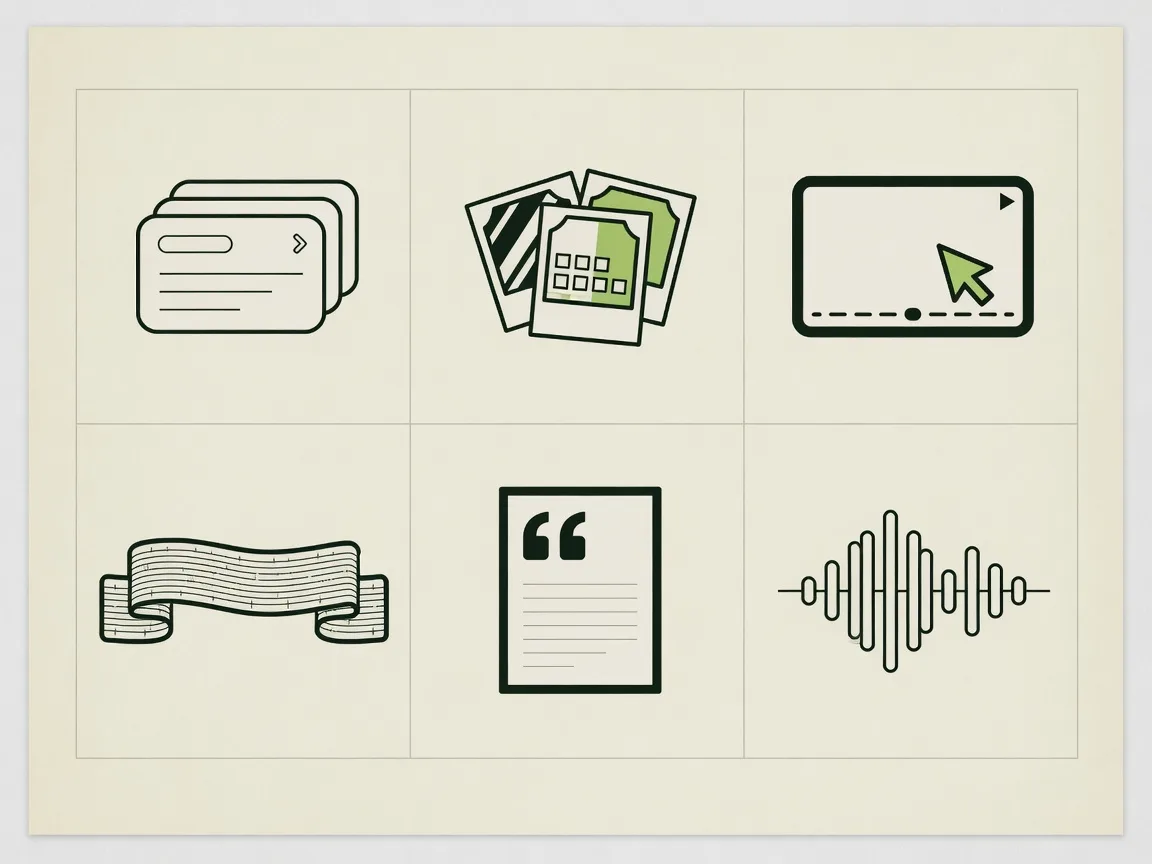
Faceless doesn't mean one format. It's an umbrella over several genuinely different production styles, each with its own effort level, its own strengths, and its own best-fit niches.
| Format | What it actually is | Works best for |
|---|---|---|
| Photo Mode slideshows | Swipeable carousel of still images with on-slide text and a caption | List-style, motivational, financial, and aesthetic niches |
| Voiceover explainer video | Stock or AI footage cut to a scripted voiceover, no camera | Facts, history, true crime, book and movie recaps |
| Screen recording / demo | Hands-only or screen-only walkthrough of a product, app, or tool | Software, apps, digital products, tutorials |
| Text-on-screen story format | A written story or confession revealed line by line over B-roll | Relationship advice, confessions, relatable niches |
| Quote / motivation cards | A single strong statement laid over a styled background image | Motivation, self-improvement, aesthetic pages |
| Infographic breakdown | Data or a comparison broken into simple visual chunks | Finance, health, productivity |
| ASMR / satisfying clips | Close, sound-focused footage of a process, no narration needed | Satisfying and process-driven niches, food prep |
Slideshows deserve extra attention because TikTok built them as a first-class format, not an afterthought. The company introduced Photo Mode carousels in October 2022 as a dedicated way to post swipeable image sets with captions and sound, distinct from video (TikTok Newsroom, Inspiring creativity with our new editing tools, 2022). The format matters more now than it did at launch, because TikTok has kept pushing itself as a place people search rather than just scroll. Sprout Social's Q2 2025 Pulse Survey found 76 percent of Gen Z use TikTok regularly and 41 percent of millennials say they now start a search there instead of a traditional search engine, with high-quality posts seeing follower growth over 40 times greater than average content (Sprout Social, 2025). A slideshow's on-slide text and caption are both searchable inside the app, which gives a faceless page a second, slower-burning source of views long after the original post drops out of the For You feed.
Pick one format to start, not three. A page that's consistent in one format builds a recognizable pattern for both viewers and the algorithm; a page that rotates between voiceover video, slideshows, and quote cards every few days reads as unfocused, and it multiplies the production skills you need to keep up. Add a second format only once the first one has a real posting history behind it.
The most common early mistake isn't picking the wrong format. It's picking a format that doesn't match how much raw material a niche actually produces. A recipe page can source new content indefinitely; a page built entirely around one narrow news cycle runs out of things to say in a few weeks. Match the format to a topic with enough depth to still be postable a year from now.
Choosing a niche you can actually sustain.
The niche decision matters more than the format decision, and it's the one creators rush past fastest. A good faceless niche needs to clear four bars at once: there has to be enough raw material to post daily without repeating yourself for months, the topic has to be something people actively search for or save content about, there has to be a plausible path to money in or adjacent to the niche, and it has to be something you can stand to work in for the length of time it takes to build an audience, which is usually longer than people expect.
| Niche | Content supply | Typical monetization fit |
|---|---|---|
| Personal finance & budgeting | High: saving, debt, investing basics, money mistakes | Strong: affiliate offers, brand deals, digital products |
| Self-improvement / motivation | High: quotes, routines, habit breakdowns | Moderate: digital products, coaching funnels, brand deals |
| Book & media summaries | High: new releases plus a deep back catalog | Moderate: affiliate links, newsletter funnel |
| Recipes & food | Very high, seasonal and effectively endless | Strong: TikTok Shop kitchenware, brand deals, digital cookbooks |
| History & interesting facts | High, effectively unlimited source material | Moderate: mostly brand deals and off-platform funnel |
| Home, aesthetic & luxury lifestyle | High, product-driven by nature | Very strong: TikTok Shop affiliate is a near-perfect fit |
| Pets | High, evergreen and broadly likeable | Strong: TikTok Shop pet products, brand deals |
eMarketer projects TikTok Shop's US GMV to clear $20 billion in 2026 and surpass $30 billion by 2028, with the platform already accounting for close to a fifth of US social commerce in 2025 and projected to approach a quarter of it by 2027 (eMarketer, via Retail Dive, 2026). Niches that sit naturally next to a physical product, home goods, kitchenware, pet supplies, beauty, have a much shorter path from page with an audience to page with a TikTok Shop commission check than niches that don't, which is worth weighing alongside personal interest when picking a lane.
Two mistakes show up constantly. The first is picking a niche so broad, lifestyle, motivation, facts, that it never builds a specific, searchable identity, and the page becomes generic and gets buried under a thousand others doing the same thing. The second is picking a niche purely for its earning potential with zero underlying interest, and burning out on it in six weeks once the novelty of having a faceless page wears off. The niches that last usually sit at the intersection of those two failure modes: specific enough to be findable, sustainable enough to survive a bad month.
TikTok Shop, brand deals, and the other real income channels.
A faceless page makes money the same way any content page does: it owns attention and points that attention somewhere valuable. TikTok itself is the distribution layer, not the paycheck, and that's worth being direct about, because TikTok's Creator Rewards Program, the platform's main video payout mechanism, explicitly excludes Photo Mode and slideshow posts from earning a payout, no matter how many views they get (TikTok Creator Academy, Creator Rewards Program eligibility; TikTok Legal, Creator Rewards Program Terms). Our full breakdown of that exclusion and the numbers behind it lives in does TikTok pay for slideshows, but the short version for a faceless page planning its income is this: budget for TikTok Shop, brand deals, and an off-platform funnel, not a per-view payout.
| Channel | How it works | Best fit |
|---|---|---|
| TikTok Shop affiliate | Tag a seller's product in a post or slideshow slide, earn a commission on sales through that link | Product-adjacent niches; works directly inside a slideshow |
| Brand deals / UGC | Paid a flat fee to create sponsored content for a brand | Any niche once there's a portfolio of consistent views and saves |
| Off-platform funnel | Bio link to a newsletter, digital product, or storefront | Every niche; the most durable channel since TikTok can't change the rules on it |
| Digital products | Templates, guides, presets, or courses sold directly to the audience | Finance, self-improvement, recipes, anything with a teachable skill |
TikTok Shop's affiliate program is open to personal accounts with roughly 5,000 followers, and sellers, not TikTok, set the commission rate, typically 5 to 20 percent, occasionally higher on promotional items (TikTok Seller University, How Standard Affiliate Commission Works, 2026). It's the closest thing to a native payout a slideshow format has, since a product tag can sit directly on a slide without interrupting anything the way a mid-video call-out can.
| Metric | Example value |
|---|---|
| Views | 60,000 |
| Click-through to tagged product | 2% (1,200 clicks) |
| Conversion rate | 4% (48 sales) |
| Average order value | $35 |
| Commission rate | 15% |
| Estimated payout | ~$125 |
Illustrative example built on typical TikTok Shop affiliate benchmarks, not a verified data point (TikTok Seller University, 2026).
Treat that math as illustrative. It's not a living wage on its own, but stacked across a month of daily posting, plus one or two brand deals once the page has a few months of consistent numbers to show, it adds up to a real, if lumpy, income. Actual results vary enormously by niche, audience quality, and how well the product fits the content.
Brand deals scale differently than affiliate income, because you're paid a fee up front rather than a cut of sales, which makes them the highest-leverage channel once a page has real proof behind it. A niche page with consistent 50,000-plus view posts, screenshots of saves and shares, and a clean, on-topic content history is a fundable asset to a small brand even without a huge follower count. Brands buying this kind of content tend to weight format fit and engagement over raw audience size.
The first brand deal came from screenshotting my own analytics and just asking. I didn't wait to feel big enough.
dez, Deeporax user
Building income off TikTok: newsletters, digital products, and your funnel.
The off-platform funnel is the least glamorous channel of the four and the most underrated, because it's the one channel a platform policy change can't touch. Every post is effectively a free ad for whatever sits behind the bio link, and increasingly, that's a newsletter or a small digital product rather than just a generic storefront.
Newsletter platforms have grown into a real secondary income layer for exactly this kind of audience-owning strategy. On beehiiv, paid subscription revenue hit $19 million in 2025, up 138 percent from 2024, and subscription income climbed from roughly 30 percent to about 85 percent of total creator revenue on the platform as more niche creators leaned into it (beehiiv, The State of Paid Newsletters 2026). Reported writer earnings on the platform range from a few hundred dollars a month for a new list to $50,000 or more for an established one in a high-value niche, though the median is far more modest: a 1,000-subscriber list in a lower-intent niche like travel reportedly earns around $252 a month, while the free-to-paid conversion for the strongest finance and investing lists reaches 18 to 20 percent (beehiiv, 2026). The gap between those numbers is almost entirely about niche and list size, the same variables that determine everything else in this guide.
Digital products, templates, guides, presets, mini-courses, remain one of the higher-margin options for a faceless page, since there's no physical fulfillment involved once the product exists. Print-on-demand is the physical-product equivalent for niches that lend themselves to merchandise, and it's a genuinely large market: the global print-on-demand industry is valued at more than $12 billion today and is projected to reach $19.8 billion by 2029, run largely through around 228,000 active stores (Printful, Print-on-demand statistics in 2026). It's also a competitive, thin-margin business in practice, only about 24 percent of print-on-demand shops are still operating three years after launch, so treat it as a channel to add once a page has an audience, not a starting point before one exists (Printful, 2026).

Whichever mix you land on, the data on income diversification is consistent: creators running three or more revenue streams earn about $75,000 more a year on average than creators depending on just one, and the share of creators leading with brand deals specifically has fallen to around 23 percent as more shift toward owned channels like affiliate income, digital products, and subscriptions (Kit, State of the Creator Economy). A faceless page's version of that same lesson is straightforward: don't build the whole plan around whichever channel is easiest to set up first.
For a rough sense of scale, an illustrative pattern seen across niche pages studied for this guide: a recipe-focused faceless page posting daily nets somewhere in the $600 to $1,000 range most months once a small digital recipe collection, a couple of TikTok Shop kitchenware tags, and one recurring brand partnership are all running at the same time. No single post produces that number. It's the compounding of consistent volume across a full month, across three channels instead of one.
Where faceless marketing goes wrong.
Most of the failure modes below aren't about the format. They're about what people do once a faceless page starts working and they try to scale it faster than the content or the platform can absorb.
The clearest recent example is what happened to a wave of faceless YouTube channels. In a six-month enforcement push, YouTube's automated Scalable Cluster Termination System removed roughly 130,000 channels grouped into 50,000 clusters of near-identical, templated content, with a January 2026 wave alone accounting for 16 channels, about 35 million combined subscribers, and 4.7 billion lifetime views (Fstoppers, 2026; Futurism, 2026). CEO Neal Mohan was direct about the target.
Actively building on our established systems that have been very successful in combatting spam and clickbait, and reducing the spread of low quality, repetitive content.
Neal Mohan, CEO, YouTube
YouTube was equally direct that faceless formats themselves were never the target: a channel that never shows a face but has real research, a real script, and real variation between uploads stays eligible for monetization. What got removed was sameness at scale, the same structure, the same synthetic narration, the same visual template, published faster than any real production process could sustain. TikTok runs a parallel version of this same rule under its own originality policy, which separately names templated slide videos and low-effort compilations as content that won't earn platform rewards regardless of view count (TikTok Creator Academy, Originality Policy).
A second common failure is building the entire plan around one income channel, usually whichever one was easiest to set up. TikTok's own history is the cautionary tale here: the original Creator Fund paid a fraction of a cent per view before TikTok replaced it with the Creator Rewards Program, which TechCrunch reported increased total creator payouts industry-wide by more than 250 percent after the switch (TechCrunch, 2024). Anyone whose entire plan was collect Creator Fund payouts had to rebuild from nothing when that program changed. A page spread across TikTok Shop, one or two brand relationships, and an off-platform list absorbs a single channel's bad month, or its disappearance, without the whole thing collapsing.
Faceless doesn't eliminate burnout, it relocates it. The pressure moves from personal, on-camera performance to volume: sourcing, scripting, and formatting enough content to post daily, every day, indefinitely. Sixty-eight percent of creators surveyed by Billion Dollar Boy cited algorithmic pressure specifically as a major stressor, independent of whether they appear on camera (Billion Dollar Boy, via Later, 2025). Building a repeatable process, or automating the mechanical parts of it, is less a nice-to-have and more the actual answer to that specific failure mode.
One more failure mode worth naming briefly: buying followers or engagement to look established faster. It doesn't survive a brand's own due diligence, and it actively works against the proof of real audience that makes brand deals and affiliate applications possible in the first place. Slower, real growth outperforms it every time this actually gets tested.
Where automation actually helps, and where it doesn't.
Given everything above, the honest case for automation is narrower than most tool marketing suggests. Automation is genuinely good at the mechanical, repeatable parts of running a faceless page: sourcing and organizing images, formatting them into a consistent slideshow layout, scheduling posts so the account never goes quiet, and surfacing which of last month's posts actually performed so the next batch can improve on it.
It is not good, and platforms are actively punishing this specific failure, at replacing the two decisions that still need a human: what's actually worth posting in this niche this week, and whether this batch of content reads as one more templated copy of everything else in the niche or as something with a genuine point of view. That's the exact line YouTube drew in its enforcement wave and the line TikTok draws in its originality policy: the tool isn't the problem, mass-produced sameness is.
| Task | Good fit for automation | Still needs a human |
|---|---|---|
| Sourcing & organizing images | Yes | |
| Slide layout & formatting | Yes | |
| Posting on a fixed schedule | Yes | |
| Performance tracking | Yes | |
| Picking the week's topics | Yes, niche judgment | |
| Writing the first draft of a hook | Partial, a starting draft | Yes, needs a real edit |
| Deciding when a format is stale | Yes |
This is the specific gap Deeporax is built to close: sourcing images, drafting hooks from a pool that's tuned against what's actually working, laying out the slides, and publishing on a schedule, so the mechanical half of running a page happens without someone doing it by hand every day. The niche call and the final read on whether a post is any good still sit with whoever's running the page, which is exactly where they should sit.
A 30-day plan to launch a faceless page.
None of the above requires a perfect plan on day one. Here's a realistic first month for someone starting from an idea and nothing else.
| Week | Focus | Action |
|---|---|---|
| Week 1 | Foundation | Pick one niche and one format using the checklist above; write a starter pool of 20 hooks before posting anything |
| Week 2 | Consistency | Post daily; resist adding a second format or niche no matter how a single post performs |
| Week 3 | Monetization setup | Apply for TikTok Shop affiliate access if the niche fits; set up a simple bio link destination, even a single-page signup |
| Week 4 | First outreach | Screenshot your best-performing posts and send one brand outreach message; review which hooks and topics worked and cut the rest |
For the automation piece in week two, our guide on how to automate TikTok slideshows with AI covers the full posting pipeline, and a fresh pool of first-slide ideas lives in our hook library. If the account is new, spend real time on how to warm up a TikTok account before pushing daily volume, since a rocky start can suppress everything that follows. And because TikTok increasingly rewards content that answers what people are actually searching for inside the app, it's worth reading TikTok SEO for slideshows before finalizing which topics to cover first.
If any part of the pipeline leans on AI-sourced images, scripts, or voiceovers, true for most faceless operations at this point, read TikTok's AI content policy for creators before scaling posting volume. Disclosure and detection rules have moved enough in the last year that assumptions from even six months ago aren't a reliable guide anymore.
Frequently asked questions.
What is faceless marketing?+
Faceless marketing is building an audience, brand, and income around a topic or format instead of a person's face and voice. Content can still have a consistent name and tone; what makes it faceless is that a different editor or workflow could produce the next post without the audience noticing a change.
Is faceless marketing the same as anonymous branding?+
They overlap but aren't identical. An anonymous brand simply doesn't name a founder; a faceless content page specifically avoids relying on any one person's on-camera presence, even if the page has a consistent voice or persona.
Do faceless pages actually grow as fast as face-forward creators?+
Growth speed depends far more on niche fit and posting consistency than on whether a face appears. Platforms increasingly weight engagement and content match over identity, which is part of why the faceless creator category has expanded so quickly (Digiday, 2025).
What platforms work best for faceless content?+
TikTok, YouTube through faceless-friendly formats like voiceover explainers, and Instagram Reels are the three most common homes for faceless content, with TikTok's Photo Mode carousels acting as the most format-native faceless option of the three (TikTok Newsroom, 2022).
Do I need any equipment to start a faceless page?+
No camera or microphone for your own voice is required for most faceless formats. A phone or laptop for sourcing images and writing captions, plus a scheduling or automation tool, covers the baseline setup.
How do I pick a niche for a faceless page?+
Choose a topic with enough raw material to post daily for a year without repeating yourself, real search or save intent behind it, a plausible path to money either directly or through an adjacent product, and enough personal interest that you'll still want to run it in six months.
Which format should I start with?+
Pick one format and stick with it through your first real posting history, usually four to six weeks, before adding a second. Photo Mode slideshows are the lowest-effort starting point for most niches since they only require source images and copy, not filming or voiceover work.
How do I make money from a faceless TikTok page?+
Set up TikTok Shop affiliate tagging first if the niche fits a physical product, since it works directly inside a post. Add brand deals once you have a portfolio of consistent views and saves, and build an off-platform funnel, a newsletter or a simple digital product, behind your bio link so income doesn't depend on any single platform's rules staying the same.
How many followers do I need before I can monetize?+
TikTok Shop's affiliate program is generally open to personal accounts with around 5,000 followers (TikTok Seller University, 2026). Brand deals don't have a fixed threshold; brands weigh consistent views and saves more heavily than raw follower count once a page has a clear niche.
Should I automate my faceless page from day one?+
Automate the mechanical parts, sourcing, formatting, and scheduling, as early as it's useful. Hold off on fully automating the niche and hook decisions until you have enough posting history to know what's actually working; automation without that judgment tends to produce the templated sameness platforms are now actively penalizing.
My faceless page isn't growing even though I post daily. What's wrong?+
The two most common causes are a niche too broad to build a specific identity, or a format mismatched to how much content the niche can actually support. Audit whether your last 20 posts could be mistaken for a dozen other accounts; if so, narrow the angle before posting more.
Can my faceless slideshow page earn TikTok's Creator Rewards Program payouts?+
No. TikTok's Creator Rewards Program is limited to original video over one minute long; Photo Mode and slideshow posts are explicitly excluded regardless of views (TikTok Creator Academy; TikTok Legal, Creator Rewards Program Terms). See our full breakdown in does TikTok pay for slideshows.
Why did my faceless content get flagged as low quality or unoriginal?+
Platforms increasingly detect templated sameness, not the absence of a face. TikTok's originality policy and YouTube's inauthentic content policy both target mass-produced content built from the same structure and visual template with little real variation between posts (TikTok Creator Academy, Originality Policy; Fstoppers, 2026). Add real research, a distinct angle, or genuine variation between posts to avoid the flag.
My page is growing but not making money. What am I missing?+
Usually a missing or unset-up monetization channel rather than a traffic problem. Confirm TikTok Shop affiliate eligibility if the niche fits, check that your bio link actually leads somewhere, a newsletter signup or product page, not a dead link, and start reaching out to brands directly once you have a few months of consistent numbers.
I'm burning out running a faceless page even though I never show my face. Is that normal?+
Yes, it's a documented pattern, not a sign you're doing it wrong. Research on creator burnout links it strongly to algorithmic and volume pressure rather than personal on-camera exposure alone (Billion Dollar Boy, via Later, 2025; Nguyen & Duffy, 2026). Automating the mechanical parts of production, sourcing, formatting, scheduling, is the most direct way to reduce that specific load without slowing your posting cadence.
Sources.
- Digiday: WTF is behind the explosion of faceless creators? (2025)
- Goldman Sachs Research: The creator economy could approach half-a-trillion dollars by 2027
- Retail Dive: TikTok Shop drives social commerce growth (eMarketer data, 2026)
- Sprout Social: TikTok SEO, the essential guide for brands in 2026
- TikTok Newsroom: Inspiring creativity with our new editing tools (2022)
- Search Engine Journal: TikTok Adds New Photo Feature to Rival Instagram
- Fstoppers: How a Google Machine Terminated 130,000 AI Slop YouTube Channels in Six Months (2026)
- Futurism: YouTube Now Shutting Down Channels Posting AI Slop (2026)
- Later: The hidden cost of creator burnout (Billion Dollar Boy survey, 2025)
- The Conversation: The hidden burnout crisis facing social media marketers
- Nguyen, R. & Duffy, B.E.: "Creator burnout is real": Risk, responsibility, and un/speakability in the creator economy (2026)
- Kit (ConvertKit): State of the Creator Economy Report
- beehiiv: The State of Paid Newsletters 2026
- Printful: Print-on-demand statistics in 2026, market data and insights
- TikTok Creator Academy: Creator Rewards Program, how to qualify and enroll (2026)
- TikTok Legal: Creator Rewards Program Terms (US)
- TikTok Creator Academy: Understanding TikTok's Originality Policy
- TikTok Seller University: How Standard Affiliate Commission Works
- TechCrunch: TikTok says its revamped Creator Fund has increased total creator revenue by over 250% (2024)
- Deeporax inspiration database (2026)
Written by
Deeporax Team
Field notes from the team building Deeporax, written from live account data across thousands of faceless TikTok pages.